THE LEGACY SERIES EP 1: BLACK BEAR DINER— LEBEC, CA.


THE LEGACY SERIES: BLACK BEAR DINER, LEBEC CA.
The Bear Still Has a Story to Tell
There is something remarkably clear about Black Bear Diner before you ever sit down:
You know where you are.
The carved wooden bear standing outside. The lodge-inspired architecture. The paw prints. The bears tucked throughout the restaurant. The newspaper-style menu. Even the merchandise display filled with stuffed bears.
In an industry where restaurant concepts are increasingly polished into interchangeable versions of one another, Black Bear Diner still has an identity.
And that may be one of the biggest reasons it’s still here.
Founded in Mount Shasta, California, in 1995, Black Bear Diner was built around a simple proposition: generous portions of familiar American comfort food served inside a playful, nostalgic mountain-lodge environment. More than 30 years later, that concept has expanded far beyond its Northern California roots.
But during a recent stop at the Black Bear Diner near Tejon Ranch, California, I found something more interesting than nostalgia.
I found a brand whose concept remains stronger than some of the details supporting it.
And for restaurant operators, that’s worth examining.
A Brand That Knows Exactly What It Is
Black Bear Diner understands something many restaurant companies spend millions trying to manufacture: distinctiveness.
You can recognize this restaurant without reading the sign.
The exterior is warm, rustic and unmistakably Black Bear. A giant carved bear welcomes guests before they reach the front door. Inside, the storytelling continues.
Bears aren’t simply a logo pasted onto menus. They’re incorporated into the architecture, merchandise, language and food names. The menu itself arrives as The Black Bear Gazette, transforming something as ordinary as ordering breakfast into another brand touchpoint.
Items like The Grizz, Bob’s Big Bear Burger, Bear’s Choice Breakfast and Bear Claws keep reinforcing the same universe.
That consistency matters because strong restaurant brands don’t merely sell food.
They create a world guests recognize.
And the menu knows exactly who inhabits that world.
Black Bear isn’t chasing culinary trends. Its proposition is unapologetically American comfort food: pancakes, eggs, biscuits and gravy, chicken-fried steak, burgers, meatloaf, pot roast, fried chicken, sandwiches, pies and enormous breakfasts. There are also smaller portions through its “Little Less” selections.
During our visit, the dining room appeared to skew toward older couples and individual travelers or truckers—an audience perfectly aligned with the proposition and with this particular location along a major travel corridor.
For someone who has spent hours on the freeway, Black Bear doesn’t require explanation.
Pull off the road and you immediately understand the promise:
Familiar food. Generous portions. Approachable pricing. A comfortable booth.
That’s powerful positioning.
Value Is Part of the Product
One thing Black Bear communicates extremely well is abundance.
Even without ordering food during this visit, the menu makes the value proposition obvious. Large breakfasts around the $20 range combine multiple proteins, eggs and sides. Burgers, sandwiches and diner classics largely occupy approachable casual-dining price points, while the menu photography reinforces portion size relentlessly.
You’re not being sold restraint.
You’re being sold plenty.
In a restaurant economy where guests increasingly question what they’re receiving for their money, perceived abundance can be a significant competitive advantage.
The beverage menu produced one particularly interesting example.
I ordered a Cabernet Sauvignon for $7.99. My server returned with what appeared to be the remainder of the bottle—roughly three-quarters of the expected pour—and explained that they had run out. Her solution was to bring me an additional partial glass of Pinot Noir.
Unconventional? Absolutely.
Generous? Also yes.
But then I noticed the pricing.
A glass of Cabernet was $7.99.
The entire bottle was $19.99.
A standard 750 mL bottle contains approximately five 5-ounce glasses. At the listed glass price, that’s roughly $39.95 in potential by-the-glass sales versus $19.99 for the bottle.
Of course, wine by the glass normally carries a higher proportional markup. Restaurants assume open-bottle risk, potential spoilage and the convenience of allowing guests to purchase a single serving.
But the difference here is substantial enough to raise an operational question: is the $19.99 bottle deliberately being used as an aggressive value proposition, or is there revenue being left on the table?
Either way, it’s a reminder that sometimes profitability isn’t hidden inside a complicated operational overhaul.
Sometimes it’s sitting quietly on the beverage menu.
When Execution Works Against the Brand
The biggest weakness I observed wasn’t the concept or the menu.
It was the room.
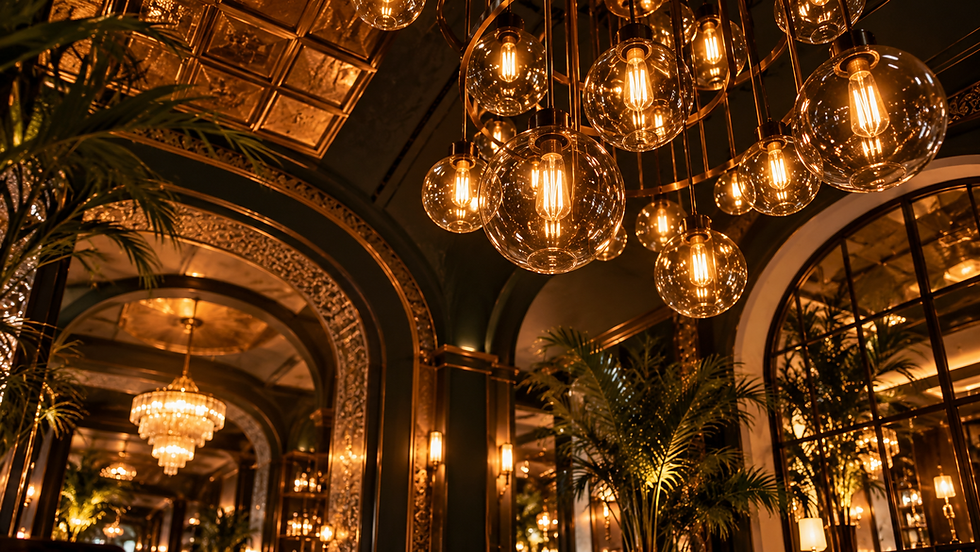
Tejon Ranch gets hot, and understandably, the blinds were lowered against the afternoon sun. But that created another problem: the restaurant became extremely dark.
More importantly, many of the fixtures hanging above the tables appeared not to be illuminated. In the area visible to me, only a fraction seemed to be producing light.
The result wasn’t cozy cabin lighting.
It felt dreary.
That’s an important distinction.
Lighting is one of the simplest ways to dramatically affect how a restaurant feels. You can have the right architecture, furniture, branding and décor, but if guests can’t properly see or experience them, you’ve diminished an investment you’ve already made.
For a brand built around warmth and comfort, the physical environment should feel like a cabin you want to settle into.
Darkness alone doesn’t create warmth.
There were similar opportunities within beverage execution.
The Cabernet interaction itself revealed an inventory issue: the restaurant had sold through the wine I ordered and apparently had no replacement bottle available. The server also pronounced the final “t” in Cabernet.
That is hardly a catastrophic service failure at a diner, nor should it be treated as one. But it illustrates something restaurant operators sometimes underestimate:
Product knowledge matters at every price point.
If you’re going to sell wine, your team should be comfortable with the wines you’re selling. If you’re going to sell beer, they should understand the beer selection. If you’re going to promote signature food, they should know what makes it signature.
Training isn’t exclusively a fine-dining investment.
Confidence creates credibility. And credibility affects sales.
My companion’s beer choice provided another small clue. He ordered something he wouldn’t ordinarily choose because, in his words, the selection was “slim pickings.”
Black Bear Diner certainly doesn’t need a sprawling craft-beer program. But beverage assortment deserves the same intentionality as food assortment, particularly at highway-adjacent locations serving travelers who may be finished driving for the evening.
The Opportunity Isn’t Reinvention. It’s Stewardship.
This is where the distinction between a restaurant review and restaurant analysis matters.
It would be easy to walk into an aging dining room, notice missing lightbulbs and conclude that the concept itself is tired.
I don’t think that’s the lesson here.
The bones are strong.
Black Bear has something many struggling restaurant concepts desperately need:
A reason to exist.
It has recognizable branding, nostalgia, accessible pricing, enormous perceived value, broad menu appeal, family friendliness, merchandise, signature language and a story.
It even uses its menu to tell guests about its origins and community involvement rather than surrendering that valuable piece of real estate exclusively to food descriptions.
Those aren’t accidents.
They’re brand assets.
And that’s why I wouldn’t prescribe reinvention here.
Black Bear Diner doesn’t need to become cooler. It doesn’t need neon signs, a DJ brunch, $18 cocktails or whatever restaurant aesthetic happens to be trending on social media this year.
Trying to modernize the soul out of Black Bear Diner would be a mistake.
What a concept like this needs is disciplined stewardship of the thing that already works.
Replace the lightbulbs. Protect the warmth of the dining room. Train the team on the products they’re selling. Review beverage assortment. Audit pricing. Maintain the physical property. Protect hospitality standards.
And keep the bear exactly where he is.
Because legacy restaurant brands don’t survive by becoming something else.
They survive by understanding what should evolve—and what should never change.
More than 30 years after the first Black Bear Diner opened in Mount Shasta, the brand still knows what it is.
That may be its greatest competitive advantage.
The bear doesn’t need a new identity.
He just needs someone to keep the lights on.
⸻
The Legacy Series: Why They’re Still Here examines enduring restaurant brands through the lens of operations, hospitality, positioning and profitability.
This visit was independently conducted. No complimentary food or beverage was received, and Black Bear Diner did not sponsor or participate in this analysis. Food was not ordered during this visit; observations regarding the menu are based on menu and brand presentation rather than food execution.




Comments